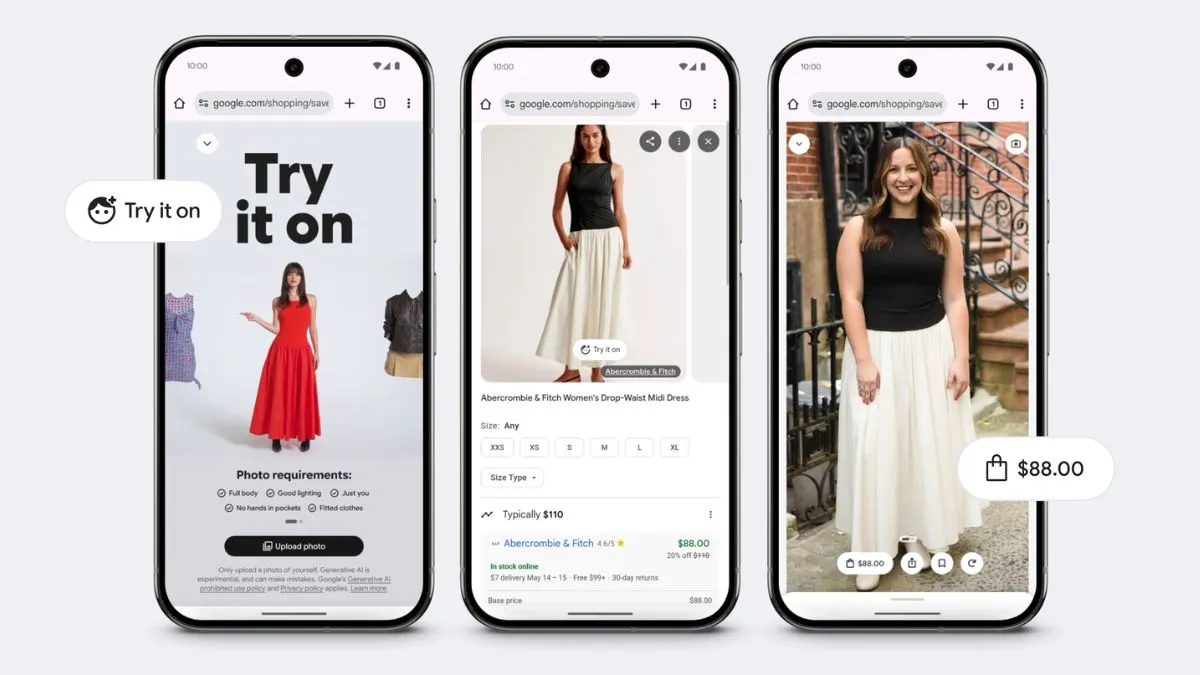
Google is expanding its footprint in AI-driven retail with the global rollout of its Virtual Try-On feature—now officially available to users in India. First previewed at Google I/O, the feature allows shoppers to “try on” clothing virtually using a single photo, generating a realistic preview of how an outfit would look on their body in real time. As online fashion continues to surge in India, this feature represents a major step toward solving long-standing challenges around fit, style, and consumer confidence.
How Google’s Virtual Try-On Works
The new try-on experience appears seamlessly across Google Shopping surfaces. When browsing apparel, users will begin seeing a “try it on” button under supported product listings. Tapping it prompts them to upload a personal photo, after which Google’s AI model does the rest. Within seconds, the system overlays a highly accurate simulation of the selected clothing item directly onto their body frame—without the awkward cut-and-paste feel typical of older try-on tools.
The technology is powered by Google’s extensive Shopping Graph, which integrates product data from thousands of retailers, and is visible across Google Shopping, Google Images, and other surfaces where clothing items appear. Once activated, the experience is simple, intuitive and designed to encourage experimentation: users can switch between looks they’ve tried before, bookmark their favourite outfits, or share them instantly through messaging apps or social media.
What Makes Google’s Approach Different
At the core of the tool is a specialised image-generation model built specifically for fashion. Google has trained this model to understand body shapes, proportions, and posture, as well as the physical behaviours of different fabrics. This means the AI doesn’t simply paste a flat product image over a user’s photo. Instead, it predicts how fabrics like cotton, polyester, denim, wool, or blended materials bend, fold, stretch, or hang on real bodies in natural positions.
This realism is what sets Google’s system apart. Whether it’s the way a sleeve falls at the elbow or how a shirt expands across the shoulders, the model attempts to display clothing as it would look in real life. With virtual try-ons historically criticised for being inaccurate or visually inconsistent, Google’s approach prioritises authenticity—paving the way for more confident online shopping decisions.
Why India Is a Key Market
India’s fashion and lifestyle sector has exploded in recent years, driven by aggressive e-commerce adoption, social commerce, and the rise of “online-first” fashion brands. Alongside this growth, India sees one of the highest return rates in online retail, particularly for clothing. Poor sizing predictions and misaligned expectations often force customers to send products back, creating losses for retailers and frustration for shoppers.
Google’s Virtual Try-On addresses these issues head-on. By giving shoppers a more accurate representation of what a product will look like on their bodies, the feature could dramatically reduce returns. It can also increase trust among first-time online fashion buyers—many of whom hesitate due to sizing or fit concerns. In a market as dynamic and diverse as India’s, offering such clarity has the potential to reshape digital shopping behaviour at scale.
Where You’ll Find the Feature
The “try it on” button will begin appearing across multiple Google surfaces where apparel items are listed, including:
- Google Shopping
- AI Mode-supported product listings
- Google Images
- Other pages connected to Google’s Shopping Graph
Google notes that more brands and retailers will continue to onboard their catalogues, expanding the number of items available for virtual try-ons. As the database grows, shoppers will gain access to a wider variety of clothing styles, colours, and sizes—all rendered automatically using the AI engine.
Gemini App Experience Also Getting a Refresh
Alongside the try-on launch, Google has revealed upcoming refinements to the Gemini app experience. Page Manager Logan Kilpatrick confirmed that the company is rolling out cleaner visuals, improved layouts, and a more intuitive interface. These improvements aim to streamline how users access tools and navigate features, especially as the Gemini ecosystem evolves to support more AI-driven capabilities. The redesigned UI is intended to enhance usability, making interactions faster, more accessible, and more visually coherent.
The arrival of Google’s Virtual Try-On feature marks an important moment for AI-assisted retail in India. As online commerce becomes increasingly immersive and personalised, shoppers expect tools that mirror real-life experiences as closely as possible. Google’s solution—powered by advanced fabric simulations and detailed body modelling—promises to remove one of the biggest pain points in fashion e-commerce: uncertainty.
As more retailers embrace the technology and the underlying model becomes more sophisticated, virtual try-ons may soon become a standard part of India’s digital shopping landscape. For consumers, this means greater confidence and less guesswork. For retailers, it means fewer returns and happier customers. And for Google, it signals yet another step toward an AI-first future in everyday digital experiences.