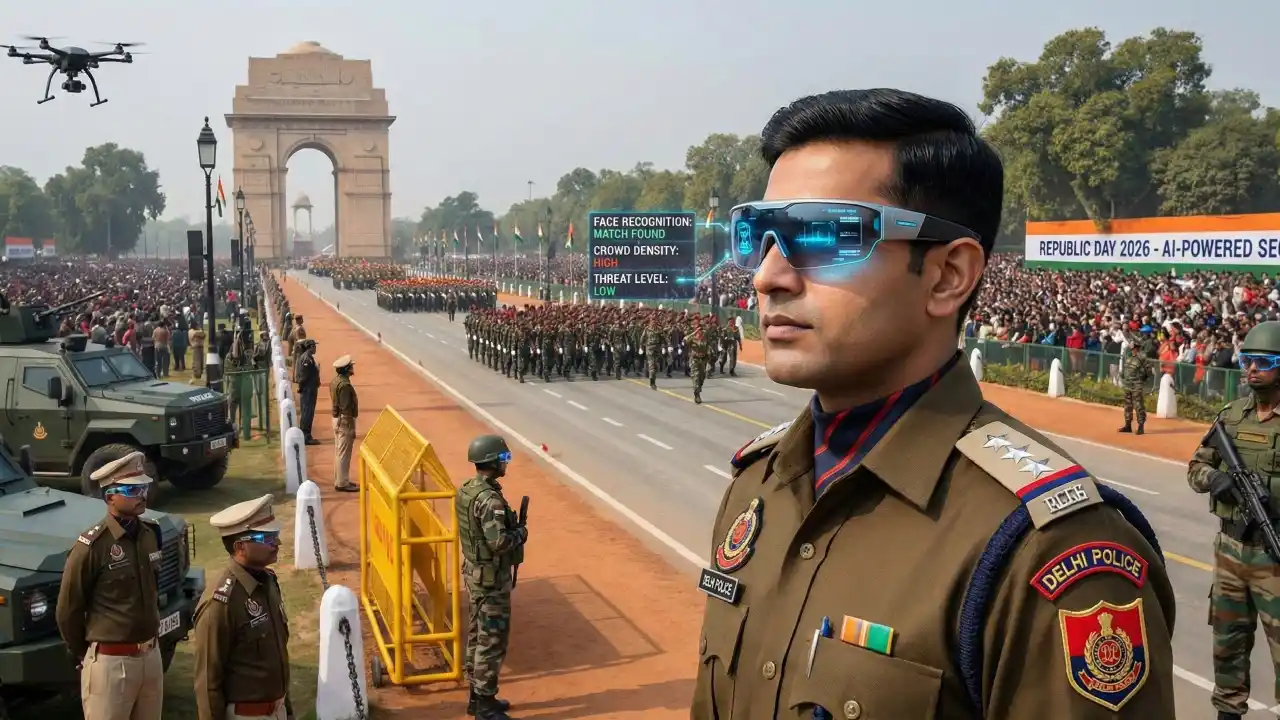
For the first time in its history, the Delhi Police will deploy AI-powered smart glasses during the Republic Day celebrations, marking a significant leap in the use of advanced technology for public security. The initiative aims to strengthen surveillance and crowd management across the national capital as thousands gather for one of India’s most important national events.
The smart glasses are equipped with Facial Recognition Software (FRS) and thermal imaging sensors, enabling officers to identify suspects in real time without stopping or disrupting the movement of crowds. According to officials, this technology allows law enforcement personnel to discreetly monitor public spaces while maintaining a smooth flow of people during the celebrations.
Developed indigenously by an Indian company, the smart glasses are directly connected to the Delhi Police database. This integration gives officers instant access to criminal records and other relevant data, significantly reducing response time in high-security situations. An official explained that the system enables identification without prompting individuals, which is particularly crucial in densely packed areas.
How the Technology Works
The smart glasses work in tandem with mobile phones issued to police officers. A senior police officer stated that when a person comes under the system’s scanner, the glasses capture live facial data and compare it against records stored in the police database. Within seconds, the system generates a result.
A green signal indicates no criminal history, while a red alert signifies that the individual has a known criminal record. This immediate visual cue allows officers to verify details quickly and take necessary action without conducting manual checks. The approach not only enhances efficiency but also minimizes inconvenience to the public.
Officials added that the facial recognition system is capable of identifying individuals even if their appearance has changed over time. By comparing live images with historical photographs, the technology ensures accurate detection, making it harder for suspects to evade identification.
Added Layer of Security With Thermal Imaging
Beyond facial recognition, the smart glasses also feature thermal imaging sensors. These sensors can help detect concealed objects such as metal items or potential weapons, adding another layer of security to the surveillance framework.
Authorities believe this feature will help eliminate reliance on traditional security procedures that may fall short in crowded environments. Thermal imaging enhances officers’ ability to assess threats quickly and discreetly, especially in areas where physical checks may be impractical.
Speaking to PTI, Additional Commissioner of Police Mahla said, “The glasses are connected to officers’ mobile phones, which carry the complete criminal database. A green box shows no criminal involvement, while a red box indicates a criminal record. The officer can verify the details quickly and take action if necessary.”
Deployment During Republic Day
According to officials, the smart glasses will be rolled out to sub-inspectors and field personnel assigned to Republic Day duties. While the police did not disclose the number of devices procured or their cost, they confirmed that an adequate quantity has been arranged to cover critical areas during the event.
This controlled deployment will allow authorities to assess the effectiveness of the technology in real-world conditions, particularly during large-scale public gatherings.
What This Means for Public Safety
The use of AI-powered smart glasses represents a progressive step in Delhi Police’s efforts to integrate cutting-edge technology into public safety operations. Officials believe the system will significantly enhance crowd management, enable faster identification of suspects, and allow officers to respond swiftly when required.
As India increasingly embraces AI-driven solutions, this initiative sets a precedent for the use of intelligent surveillance tools at major national events. If successful, the technology could see wider adoption in future public gatherings, helping ensure safety without compromising convenience or mobility for citizens.