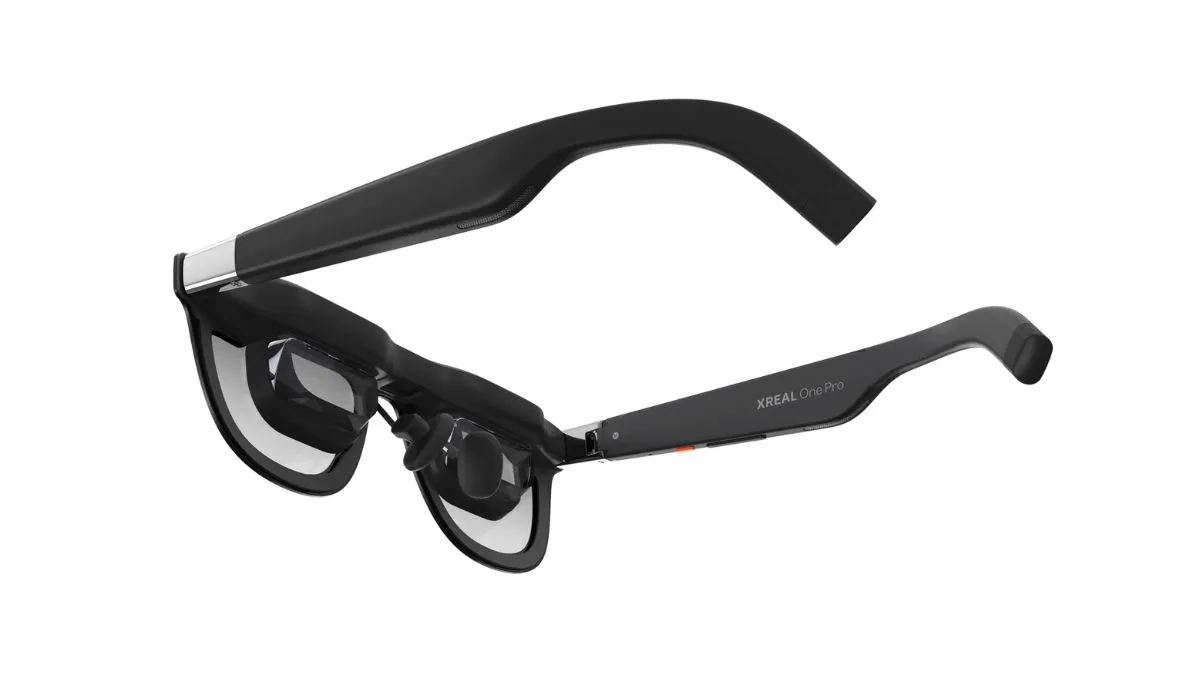
XReal has officially launched its newest pair of augmented reality smart glasses, the XReal 1S, in Japan, offering a more affordable and feature-rich alternative to its previous models. Designed for entertainment, gaming, and lightweight productivity, the 1S aims to broaden the appeal of spatial displays by delivering one of the most accessible AR experiences on the market. What truly sets this model apart is its automatic real-time 2D-to-3D video conversion, a breakthrough that marks a first in consumer AR eyewear.
With this release, XReal is positioning the 1S as the go-to choice for users who want immersive screen experiences without investing in more expensive high-end devices. Alongside the glasses, the company also introduced a 10,000 mAh companion battery pack called the Neo, expanding the versatility of the ecosystem.
Upgraded Optics and Performance
The XReal 1S arrives with noticeable improvements in visuals and hardware. It uses Sony-made 0.68-inch micro-OLED panels, each delivering a 1920 × 1200 resolution with refresh rates of up to 120 Hz. The glasses also boast 108% sRGB coverage, ensuring rich and accurate colors. One of the standout enhancements is the increase in brightness: the 1S reaches 700 nits, which is significantly higher than its predecessor and boosts outdoor visibility.
The glasses also offer a 52-degree field of view, creating a more cinematic virtual screen that floats comfortably within the user’s line of sight. These upgrades make the device ideal for watching videos, browsing, or connecting to a gaming console for a large-screen experience.
Still, the highlight is the new real-time 2D-to-3D conversion mode. Although switching to 3D reduces the refresh rate to 30 Hz, XReal’s custom X1 spatial chip steps in to manage distortion correction and frame generation across thousands of processing nodes. The chip also powers 3DoF tracking, helping the virtual screen remain anchored even as the user moves. Latency can go as low as 3 ms, which is impressive for glasses at this price point.
XReal has confirmed that this 3D mode will not be exclusive to the 1S—existing One and One Pro users will also receive the feature through a software update, extending the value of its broader product family.
Comfort-Focused Design and Improved Audio
At just 82 grams, the XReal 1S is lighter than the standard XReal One, enhancing long-term comfort. It includes flexible temples, an adjustable hinge, and multiple light transmittance settings—0%, 35%, and 100%—to match varying lighting conditions and user preferences.
Audio quality also receives a major upgrade. The open-ear speakers come with Bose-supervised tuning and support Spatial Sound 4.0, elevating immersion when watching movies or playing games. For communication, the device is equipped with four microphones, voice focus algorithms, and uplink ENC to improve call clarity. However, like all open-ear systems, external noises remain audible, which may affect calls in busy environments.
Pricing, Accessories and Availability
In Japan, pre-orders for the XReal 1S start at ¥67,980, roughly equivalent to ₹40,000. Global availability is expected in the coming months, although specific dates have not yet been announced.
XReal is also debuting the Neo battery pack, priced at ¥14,580. With 10,000 mAh capacity, it offers pass-through video designed specifically for AR glasses and doubles as a dock for Nintendo Switch consoles. Customers can purchase the glasses and battery pack together as a bundle for ¥76,560, and early buyers will receive an XReal Hub at no extra cost.
A Promising Step Forward
With brighter displays, a wider field of view, lighter construction, and the innovative 2D-to-3D conversion feature, the XReal 1S is shaping up to be one of the most compelling value offerings in consumer AR. If global pricing lands slightly above the current $399 tag of the XReal One, the 1S could easily become a top choice for newcomers to spatial displays—especially those looking for immersive entertainment without the premium price of higher-end AR devices.