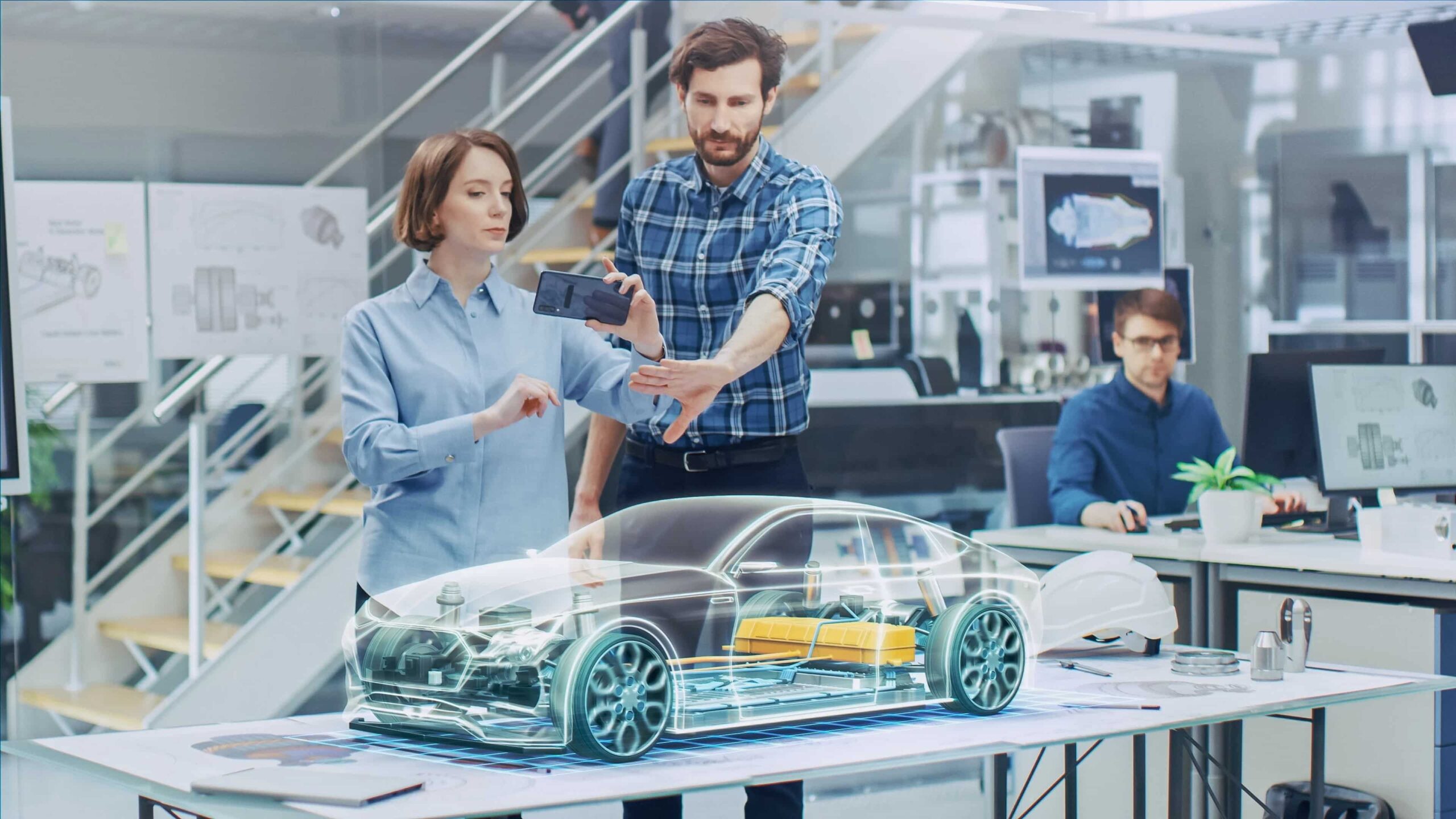
Augmented Reality has emerged as one of the most transformative technologies in the automotive sector, fundamentally reshaping every phase of the vehicle lifecycle—from design and manufacturing through sales, ownership, and maintenance. By 2026, AR applications span immersive showroom experiences, precision manufacturing, real-time driver assistance, and remote service delivery, creating competitive advantages that extend far beyond novelty applications into operational necessity.
Market Momentum and Growth Trajectory
The automotive AR market demonstrates exceptional growth momentum. The North America automotive AR/VR market is projected to reach approximately USD 2.2 billion by 2025, with projections indicating robust compound annual growth rate (CAGR) of approximately 38.5% from 2026 to 2033. The global automotive AR market is valued at USD 3.55 billion and projected to reach USD 4.16 billion by 2025, growing at a 16.87% CAGR.
This explosive growth reflects genuine industry momentum rather than speculative hype. Major OEMs including BMW, Mercedes-Benz, Hyundai, Stellantis, Volvo, and Rivian have moved AR and VR from experimental labs into production deployments. Strategic partnerships between automotive giants and technology leaders—including BMW with NVIDIA, Mercedes with Microsoft, and others—indicate sustained commitment to AR integration as core competitive strategy rather than peripheral innovation.
Revolutionary Applications Transforming the Customer Journey
Virtual Showrooms and Immersive Configuration
AR has fundamentally transformed car shopping from a dealership-bound experience into a personalized, home-based exploration. Virtual reality enables prospective buyers to walk through showrooms and explore vehicles using VR headsets or smartphones, examining interiors, checking trunk space, and visualizing dashboard layouts without leaving their homes.
Immersive walkthroughs are particularly valuable for evaluating spaciousness and layout. Buyers considering SUVs, trucks, or family vehicles can inspect cargo capacity, third-row seating arrangements, and accessibility features—spatial understanding impossible through static photos or traditional dealership visits.
Augmented reality extends this capability by placing life-sized vehicles in real-world environments. Prospective buyers using smartphones can see how an SUV would appear parked in their driveway or visualize a pickup truck’s dimensions compared to their garage space. This spatial context—understanding how a full-size vehicle actually appears in their real environments—addresses a fundamental purchase barrier: uncertainty about scale and suitability.
Major automotive brands have pioneered these capabilities. Fiat’s Metaverse Store allows users to explore vehicles virtually, tailoring options, specifications, and color trims in real-time, enabling comprehensive customization visualization before purchase. This immersive pre-purchase configuration dramatically reduces buyer uncertainty while extending engagement throughout the sales process.
AI-Powered Personalization and Recommendation
Artificial intelligence integrated with AR transforms passive browsing into actively personalized shopping experiences. AI algorithms analyzing customer preferences, search history, budget constraints, and demographic data provide tailored vehicle recommendations aligned with individual needs.
Virtual assistants and chatbots available 24/7 answer questions about financing, scheduling test drives, and vehicle specifications—services previously requiring dealership visits or business-hour phone calls. This around-the-clock support removes friction from the sales process, enabling buyers to explore and purchase at their convenience.
AI further enables predictive analytics identifying which features and configurations specific buyers will prefer based on historical data patterns. This personalization creates experiences feeling individually crafted rather than mass-produced, substantially improving buyer satisfaction and purchase likelihood.
Transforming the Driving Experience: AR Head-Up Displays
Safety-First Navigation and Driver Assistance
AR heads-up displays (HUDs) represent perhaps AR’s most immediately impactful automotive application, projecting critical information directly onto windshields or dedicated displays in drivers’ fields of view.
Traditional vehicle dashboards force drivers to glance down, diverting attention from roadways—a significant safety concern particularly at highway speeds. AR HUDs eliminate this distraction by displaying turn-by-turn navigation directions, speed, fuel levels, lane guidance, and alerts directly in drivers’ line of sight. This seamless integration enables drivers to access vital information without compromising road focus.
Real-Time Hazard Detection and Situational Awareness
Advanced driver assistance systems (ADAS) leveraging AR provide real-time hazard detection and alert generation. Object recognition technology identifies potential dangers on or near roadways, with AR systems highlighting hazards directly in drivers’ visual fields. Rather than relying on drivers’ instincts to identify dangers, AI-powered object recognition surfaces threats before they become critical.
Predictive analytics enhance this capability by filtering information presented to drivers, prioritizing essential navigation while eliminating distractions. This intelligent filtering creates safer driving experiences by preventing cognitive overload—drivers maintain focus on road threats rather than processing excessive information.
Personalized Navigation and Contextual Intelligence
Modern AR HUDs increasingly leverage AI to customize content based on driving conditions and individual driver preferences. Rather than generic navigation instructions applicable to all drivers, systems adapt display content based on current traffic conditions, weather, road hazards, and individual driving styles.
Companies like WayRay and Continental are advancing these capabilities through gesture recognition and eye-tracking technologies integrated with high-speed connectivity, enabling more intuitive, responsive HUD systems. These advancements move AR from passive information display toward intelligent, adaptive co-piloting systems.
Emerging Advanced Capabilities
Nissan’s Invisible-to-Visible technology demonstrates future possibilities, enabling drivers to potentially interact with AR co-pilots who perform decision-support functions during driving. While still emerging, these applications hint at AR’s potential to transform driving from solo activities into collaborative human-AI experiences.
Manufacturing Excellence Through AR-Enabled Digital Twins
Digital Twin Revolution and Production Planning
BMW’s Virtual Factory built with NVIDIA’s Omniverse and OpenUSD represents the pinnacle of manufacturing AR applications, simulating layouts for over 30 global plants while trimming weeks from physical planning cycles. Rather than constructing expensive physical mockups, manufacturers simulate production workflows virtually before implementation.
This digital twin approach is rapidly expanding across the industry. Hyundai, Mercedes-Benz, Stellantis, and emerging manufacturers like Rivian are building similar environments enabling predictive logistics and workforce planning. The efficiency gains are substantial—manufacturers test complex workflows, identify bottlenecks, and optimize layouts before committing capital to physical construction.
Real-Time Quality Control and Precision Assembly
AR enables quality inspectors and production workers to visualize digital tolerance guides and templates overlaid on physical components in real-time. Rather than comparing physical components against flat technical drawings, workers see misalignments, surface flaws, and missing components highlighted by AR systems, enabling instantaneous corrective action.
This real-time feedback dramatically reduces rework requirements and improves quality consistency across production lots. When combined with AI analysis of sensor data, AR systems provide predictive capabilities identifying when machines need maintenance before failures occur.
Collaborative Design and Engineering Reviews
AR enables design teams, engineers, and manufacturing specialists to collaborate on shared 3D models, with changes and comments updated in real-time. Using Autodesk’s XR-based review capabilities, managers, designers, and safety engineers stand inside digital models together, testing visibility and signing off on changes on-site.
This collaborative approach addresses a fundamental manufacturing challenge: physical separation between design teams and production facilities creates communication delays and misunderstandings. AR collapses these distances through shared visual reference.
Accelerated Assembly and Reduced Training Requirements
AR guidance through assembly tasks reduces production time through multiple mechanisms. Rather than workers referring to manuals or waiting for supervisors, real-time AR overlays provide step-by-step instructions directly in workers’ fields of view. This acceleration translates to higher productivity and reduced production downtime.
Training time for new workers decreases substantially. Rather than weeks of manual training on complex assembly procedures, new employees receive AR-guided on-the-job training enabling rapid competency development. The combination of visual guidance and immediate expert support enables even junior workers to execute high-level assembly tasks with confidence.
After-Sales Service and Remote Diagnostics
Remote Expert Assistance and Reduced Downtime
Vehicle technicians wearing AR headsets or using AR-capable tablets can receive expert guidance in real-time. Remote experts view exactly what technicians see and provide visual instructions indicating specific bolts to tighten, components to test, or procedures to follow. This capability dramatically reduces vehicle downtime by enabling problem resolution without requiring expert technicians to visit service locations.
Porsche and Ford have successfully implemented AR-enabled remote assistance in service bays, demonstrating real-world applicability and value. For complex repairs requiring specialized expertise, AR-based guidance eliminates the need to fly experts into remote markets—a substantial cost savings for manufacturers.
Precision Maintenance and Error Reduction
AR-guided maintenance provides precise visual overlays of engine components and assemblies, enabling mechanics to visualize and interact with each part in real-time. Rather than relying on memory or manual consultation, technicians see exactly which components require attention and how to access them.
This precision reduces errors and rework requirements substantially. When repairs are performed correctly the first time, customer satisfaction increases while warranty costs decrease. The economic benefit compounds when multiplied across thousands of service locations globally.
Predictive Maintenance Through AI-AR Integration
The convergence of AR with AI and IoT enables powerful predictive maintenance capabilities. AR guides workers through complex procedures while AI analyzes sensor data from embedded machines, predicting when maintenance is needed before failures occur.
Technicians receive early warnings about potential issues, enabling preventive maintenance addressing problems before they escalate. This proactive approach reduces unexpected failures, customer inconvenience, and emergency service calls—all expensive propositions for vehicle owners and manufacturers.
Formidable Implementation Challenges and Market Barriers
Despite compelling benefits, significant obstacles constrain automotive AR adoption.
High Development and Implementation Costs
The substantial investment required for developing and integrating complex AR/VR systems represents the most significant barrier. Custom AR system development, display technology, sensor integration, and software development require expertise concentrated among specialized firms.
For manufacturers integrating AR across multiple vehicle platforms and models, costs multiply substantially. This financial barrier particularly constrains smaller manufacturers and suppliers lacking capital resources of global OEMs.
Driver Distraction and Safety Concerns
A critical regulatory challenge centers on ensuring AR overlays and VR experiences don’t distract drivers, compromising road safety. Designing AR interfaces that enhance safety without creating cognitive overload requires sophisticated expertise.
Regulatory bodies remain cautious, requiring rigorous testing proving that AR systems actually improve safety rather than potentially degrading it through distraction or information overload.
Hardware Limitations and Display Technology Constraints
Current AR display resolutions, fields of view, and processing power still limit full potential of immersive AR experiences. While rapidly improving, hardware constraints occasionally frustrate aspirational AR applications. Achieving transparent, high-resolution displays providing full field-of-view coverage while remaining affordable remains technically challenging.
Standardization and Interoperability Fragmentation
The lack of universal standards for AR/VR integration hinders seamless implementation across different vehicle platforms. When each manufacturer develops proprietary AR systems incompatible with competitors’ offerings, ecosystem development suffers. This fragmentation increases development costs and slows market maturation.
User Adoption and Consumer Acceptance
Despite technological sophistication, consumer adoption remains uncertain. Many buyers remain unfamiliar with AR interfaces or skeptical about their utility. Educating consumers and gaining widespread acceptance for complex new interfaces requires sustained effort and compelling value demonstrations.
Infrastructure and Connectivity Requirements
Many AR applications depend on fast, stable internet connectivity for real-time data delivery. Rural areas lacking fiber-optic infrastructure struggle to support bandwidth-intensive AR experiences. Until universal high-speed connectivity exists, this infrastructure gap constrains deployment in underserved regions.
Strategic Applications by Market Segment
| Application Area | Primary Benefit | Maturity Stage | Key Players |
|---|---|---|---|
| Virtual Showrooms | Enhanced customer experience, expanded market reach | Advanced (2026 deployment) | Fiat, BMW, Mercedes, major OEMs |
| AR Head-Up Displays | Improved safety, enhanced navigation | Emerging to Advanced | BMW, Lexus, Toyota, Mazda, Volvo |
| Manufacturing Digital Twins | Efficiency, quality improvement, cost reduction | Advanced (scaling) | BMW, Mercedes, Hyundai, Stellantis |
| Remote Service Assistance | Reduced downtime, expert access | Emerging (specialized deployment) | Porsche, Ford, dealers |
| Real-Time Assembly Guidance | Training acceleration, error reduction | Advanced (large OEMs) | Major OEMs in high-volume production |
| Predictive Maintenance (AI-AR) | Proactive issue identification, warranty reduction | Emerging to Growth | Luxury and commercial manufacturers |
| Personalized Navigation | Safety, efficiency, driver engagement | Growth (expanding) | Navigation systems providers |
Future Outlook: 2026-2027 Trajectory
AI-Powered Intelligent Assistance
The integration of AI with AR will accelerate through 2026-2027, enabling increasingly sophisticated driver assistance and remote service systems. AI will learn individual driving patterns, adapting AR overlays and alerts to specific driver preferences and behaviors. Systems will become more intelligent about prioritizing information, minimizing distraction while maximizing safety benefit.
Haptic Feedback and Immersive Interaction
By 2027, haptic feedback technologies combined with AR/VR will create more realistic and immersive vehicle interactions. Virtual test drives could provide tactile feedback simulating acceleration, braking, and road texture—dramatically improving confidence in remote vehicle evaluation.
Cloud-Based AR/VR Services
Cloud infrastructure will enable delivery of complex AR/VR experiences seamlessly to vehicles, supporting continuous updates and personalization without requiring massive onboard processing. This cloud-based approach will enable rapid service delivery and consistent experiences across diverse vehicle platforms.
Standardization and Industry Convergence
Industry collaborative efforts among major OEMs and technology providers will likely produce standardized AR/VR frameworks by 2027, reducing fragmentation and enabling ecosystem development. Standardization will reduce development costs while accelerating market maturation.
Commercial Vehicle Applications
While passenger vehicles dominate early adoption, commercial vehicle segments—trucking, logistics, and fleet operations—will increasingly leverage AR for driver training, logistics optimization, and remote diagnostics.
Critical Success Factors for Implementation
Safety-First Design Philosophy
Successful AR implementations prioritize safety above all. Rather than adding features, manufacturers should carefully evaluate whether specific AR applications actually improve driving safety before deployment.
Gradual Feature Rollout and Consumer Education
Recognizing consumer adoption barriers, successful manufacturers will introduce AR capabilities gradually, bundled with comprehensive consumer education ensuring drivers understand functionality and benefits.
Seamless Integration with Existing Systems
AR systems that integrate transparently with existing vehicle electronics and user interfaces tend to achieve greater adoption than those requiring new behavioral learning.
Continuous Data Privacy and Security
AR systems collecting location, driving behavior, and preference data require robust security and transparent privacy policies ensuring consumer confidence in data handling.
Augmented Reality has transitioned from experimental automotive technology into an operational imperative reshaping vehicle design, manufacturing, sales, and driving experience. The evidence is compelling: virtual showrooms expand market reach while improving customer confidence, manufacturing AR enables efficiency gains saving weeks of planning time, and AR-assisted driving improves safety while reducing driver cognitive load.
The automotive industry in 2026-2027 faces not the question of whether to adopt AR, but rather how quickly manufacturers can overcome implementation barriers while capturing competitive advantages AR provides. Early-adopter OEMs gaining fluency in AR deployment are establishing competitive moats difficult for slower-moving competitors to overcome.
For automotive manufacturers, suppliers, and service organizations, the imperative is clear: strategic AR investment in sales, manufacturing, and service operations delivers measurable business value through enhanced customer experiences, improved operational efficiency, and reduced costs. The automotive AR revolution is no longer coming—it is already here, reshaping every dimension of the automotive industry from conception through customer ownership.